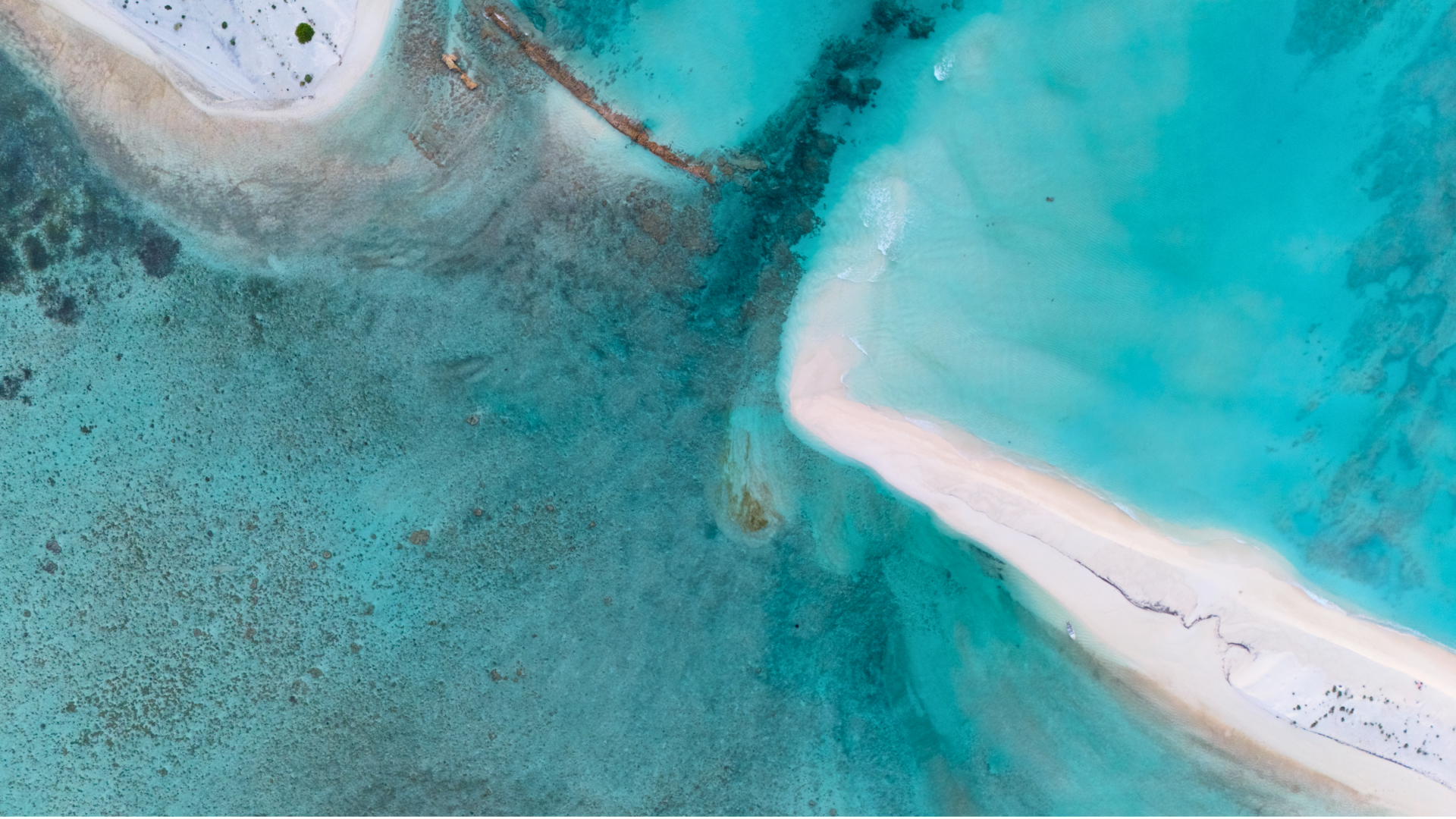
Coming back from two weeks in the distant archipelago feels a little like re-entering the world after a long, exquisite exile. Saint Brandon is an Indian Ocean archipelago, situated on the Mascarene Plateau, about 430 kms north-northeast of Mauritius, composed of sandbanks, shoals, and islets. You return sun-marked and disoriented, slightly unsure whether what you’ve seen was real or conjured by the mind in some fevered dream.
Saint Brandon is a place that happens to you. Across the reach of the archipelago, long ribbons of sand stretch unbroken for kilometres, their whiteness dissolving seamlessly into an impossible turquoise. There is no sound save for the sharp cry of the oiseaux de la vierge, those near-mythic birds that skim the air so close to you, one half expects them to ask, “Who are you, and what are you doing here?”
The waters surrounding the islets pulse with life. Schools of fish flash in metallic unison; coral flickers below, each movement refracting light as though the sea itself were breathing. It is a world unbothered by urgency, a self-contained ecosystem untouched by the notions of ownership or scarcity.
Getting there takes thirty-five hours, not counting the hours of preparation before departure. It is a journey that strips away convenience layer by layer until you are left with your most elemental self. When the last signal bar on your phone disappears and silence becomes the dominant frequency, something within you unclenches.
The absence of digital life is first unnerving, then liberating. Without constant notifications you rediscover what uninterrupted thought feels like. Days unfold according to the sway of the tide, the angle of the sun, the mindful question of what you might eat, or more precisely, what the sea might offer for supper. By the third evening, I had become a fisherwoman out of necessity and communion rather than sport. Drop a line, wait, and, more often than not, dinner finds you. There is a deep satisfaction in that simplicity, the elegant sufficiency of having just enough.
It was somewhere between one of those silent dusks, when the horizon melted into the ocean, that I grasped something quite radical. Luxury, I realised, has been misappropriated, severed from its human roots and transposed into a language of possession. We have come to associate it with numbers and names: eight-digit salaries, private jets, the monogram of Louis Vuitton or the latest iPhone, symbols that promise more but deliver distraction.
Saint Brandon dismantles that illusion. Out there, luxury is in subtraction. It is the removal of noise, addiction, competition, the entire architecture of consumption. It is not about acquiring the extraordinary, but about recognising the extraordinary within the ordinary: the precise glow of dawn, the sound of the tide folding itself into the sand, the grace of existing without a schedule.
In solitude, time loses its tyranny. You begin to feel in your bones that time is an elaborate illusion. The only time that truly exists is the one we are inhabiting, this singular now. And within that “now,” the mind finds stillness.
It is a serenity that arrives through the small acts of presence. There is also gratitude for being part of something perpetually shifting and alive. You begin to understand impermanence as the fabric of existence itself. That everything passes, and this is precisely why it matters.
And so I began to question: was I really pressing ‘pause’ on life or was I, at last, pressing ‘play’? What if all our busyness, our ambition, our endless scrolling were the real act of pause, the stasis of a life disconnected from its authentic rhythm?
Perhaps the ultimate aim is not to escape but to remember. To locate, even amidst the speed of modern living, that same stillness, that same abundance that exists naturally on an untouched sandbank in the middle of the Indian Ocean.
Luxury, then, is a condition of awareness, the ability to be fully present, to live without demand, and to see beauty not as possession, but as perception.
Saint Brandon taught me that luxury is not scarcity wrapped in desire but freedom restored by simplicity. And maybe the grandest act of modern sophistication is learning, once again, how to do nothing at all.
This site is protected by reCAPTCHA and the Google Privacy Policy and Terms of Service apply.